
Ambition & Addiction
Marty Supreme, Narcissism & How I'm Surviving Lately

In a departure from my usual lackadaisical attitude, I’ve picked some books and scheduled three meetings for The Irregular Bookclub. We’re reading Clarice Lispector, Donald Antrim & Eve Kosofsky Sedgwick this winter/spring. If you want to join us for a discussion of any or all of these books, there’s more info at the bottom of this post.
There’s always a moment (or several moments) when I’m writing a novel that everything seems to be conspiring to bring me the books, art, films, and conversations that illuminate something about the themes I’m working with.
But this first month of 2026 has been distractingly ugly, and I’ve found it hard to concentrate with the depth needed to write fiction.1 Of course, there’s been the news from Minneapolis and beyond, but there’s also been a big, stupid, sad drama affecting an important person in my life. I am (like so many others) almost constantly preoccupied with pains (both widespread and specific) that I feel almost incapable of assuaging.
Writing has less appeal at times like this, and one of the only things that genuinely helps when life feels like this, is to find a way to read more books, as far away from the internet as possible. (Lately it’s been Proust for a book club with friends, a couple memoirs that have helped me escape my life, and Elena Ferrante because I promised my pal Kendee that I’d finally read the quartet. )
Another thing that helps— I’ve also been using Brick religiously (a thing that makes your phone boring/useful instead of a black hole of your attention) and the Brick has totally stopped all dooms scrolling. (Not an affiliate link, I just love this little thing.) I decide when it’s time to read the news and I just read or listen to the voices that inform me without inflaming me. On the Media (bless you, Brooke Gladstone), Heather Cox Richardson (especially the podcast form), and How Things Work are three publications I have been leaning on lately.
And as much as Alex Chee made Heated Rivalry seem like a worthy escape, I only watched two things this January— Wim Wender’s The American Friend and the new Josh Safdie film, Marty Supreme. The former is a truly great film, and the latter is a decent film that stressed me out and ultimately left me feeling pissed off.
Marty Supreme is well-made, beautifully designed, and sometimes funny film that glorifies the unhindered, psychotic ambition of a young man who constantly and without question uses other people as instruments to achieve his own goals. This is not a spoiler, but in the end, our narcissistic hero achieves his aim, if in a slightly tainted form, and arrives at the hospital shortly after his first son is born (despite the fact that he has treated the mother of his son like she is a farm animal, at best.) He doesn’t touch his son, just looks at him through a pane of glass and cries. Awww! Hands-off fatherhood causing a lil emotional outburst! Cute!2 (I wanted to throw up.)
But what did I want the film to be that it wasn’t? Would I have preferred our manic hero to get killed in the end, like the Safdie Brothers’ Uncut Gems? It did seem true and honest for this young narcissist to simply get away with everything, face very few consequences, escape his gambits unscathed, and enjoy a superficially humbling moment of locking eyes with his progeny (of whom, it should be noted, he denies paternity until he simply can’t get away with it anymore.) I get that the implication is that Marty’s humbling is yet to come, that it will happen (if at all) off-stage, after the entirely too long 2.5 hour film he’s just been starring in.
In film, the humbling always happens off camera, because the humbling is boring, it’s a slog, it’s difficult to shoot, it has no excitement. And watching this film in January 2026, when I feel such an absence of humility and humanity, it left me feeling amped, in a bad way, and I’m glad I could walk home from the theater and blow off some steam.
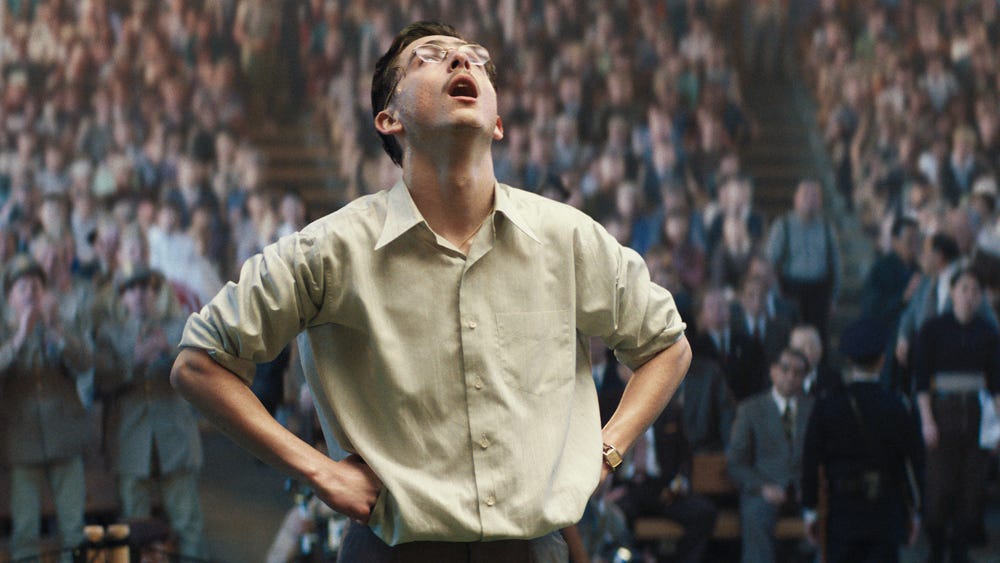
Yesterday morning, I read Hermione Hoby’s essay on the 30th anniversary of the publication of Infinite Jest, and I experienced that conspiratorial feeling I sometimes get when writing a novel, but instead of pointing me toward some unseen theme beneath my work-in-progress, Hoby’s essay reoriented and contextualized my feelings about Marty’s USA-flavored narcissism in such a way that I could feel released from the need to write anything else about them.
I’ve still never read Infinite Jest, but I will probably do so sooner rather than later thanks to the following description—
The novel also suggests—mumblingly, without making eye contact, not wanting to be corny about it—that one’s own self becomes a little less hideous the more one attends to other selves.
… [Infinite Jest] proposed that the compulsive, addictive character of America, not least its addiction to entertainment, could best be resisted through the engaged reading of fiction. Here is a book about addiction that offers itself as a kind of counter-addiction, an example of the compounding value of sustained attention.
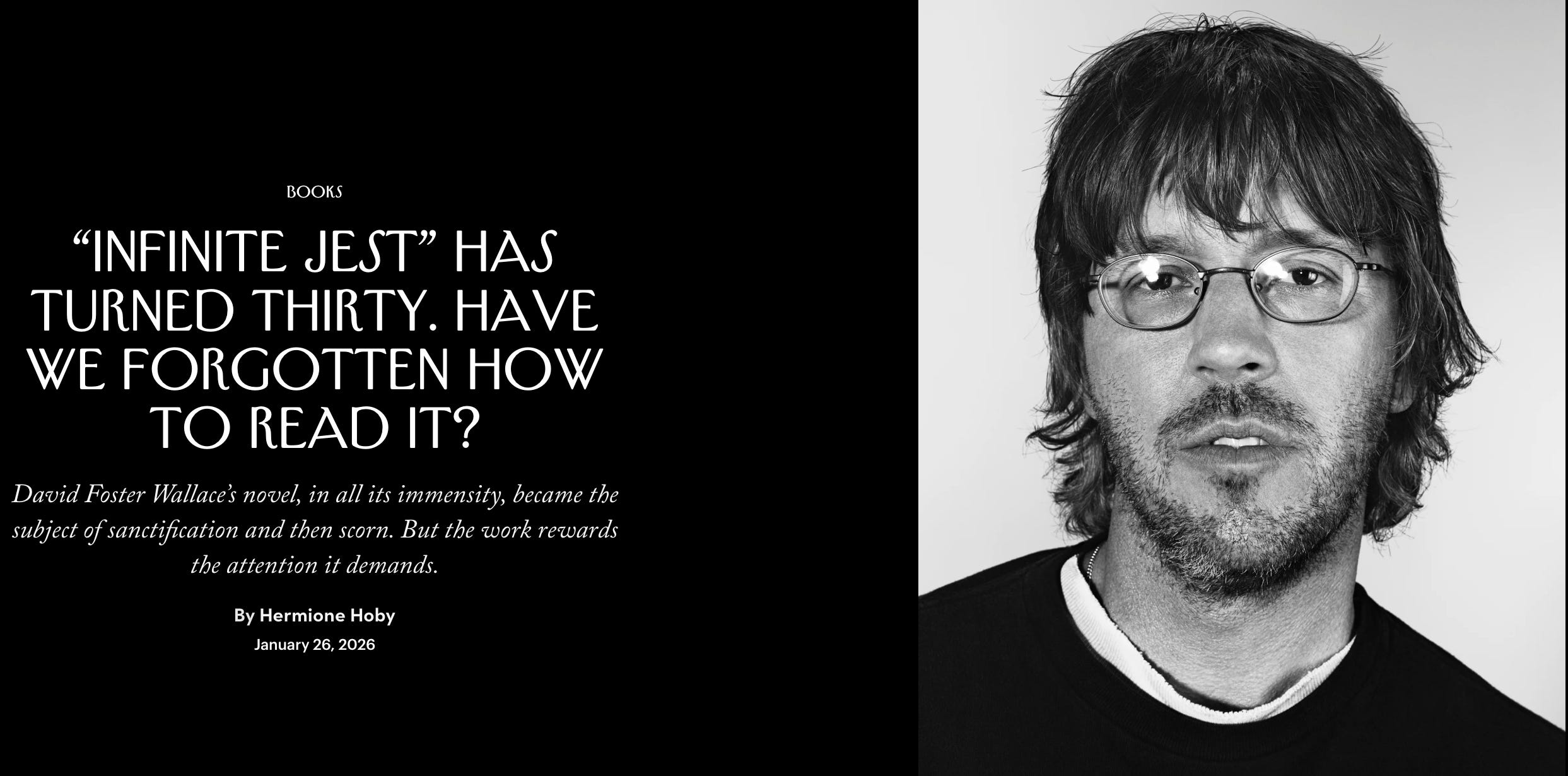
I’ll admit that part of the reason I’d never read Infinite Jest was that, even though I’ve read and loved his essays and stories, I had this feeling of wanting to avoid a longer, more sustained reading commitment with his voice. But yesterday I realized that I’d never read anything about the novel, and had just written it off probably I knew one too many dudes that gave Infinite Jest a bad rap, since I was in an MFA program when he died and was immediately made into a saint by those same dudes who mainly just drooled about the idea of writing a 1,000 page book, regardless of what it was about.
Elsewhere in the essay, Hoby names two of the themes of the book that are also themes of both Marty Supreme and almost everything else in the world right now.
Ambition and addiction… share a fat slice of their Venn diagram—an overlap that might be labelled ‘how to live with yourself.’
And that’s really the thing that is driving me mad these days. I feel like we are all suffering from the runoff of the unchecked addictions and ambitions of these fuckers in political power in the States and the tinydickenergy cowards working for ICE. Close to 100% of the dilemmas facing people in my life and people in the news stem from the fact that there are too many people with rampant ambition and power who cannot answer the simple question of “how do you live with yourself” and they’re making it everyone else’s problem.
That’s why I could not sit still during Marty Supreme. It’s a stressful thing to watch, with not a moment’s rest— there are explosions, and shoot outs, and bodily harm done to everyone including a pregnant woman, and editing3 that feels like violence in itself— and this just felt a bit too much like being a person in North America these days.
A film like Marty Supreme, much like January 2026 on earth, seems intent on numbing the senses, weakening the viewer through the sheer onslaught of action and the relentlessness of the hero. (This is also what it feels like to be in love with someone in thrall to their own addictions and ambitions.) You might leave the theater feeling like you have no choice but to roll over and accept the manic ambitions of men like that, because they’ll get what they want either way. This, in fact, is not at all true, and at least the people of Minneapolis have not succumbed to this lie.
In contrast, The American Friend, does not paint a rosier picture of human nature or ambition, but it leaves your nervous system intact. So— skip Marty Supreme. Stay home and watch The American Friend on Criterion Collection. That’s about as close as I’ll get to a hot take.
I’ll leave you with another zinger from the Hoby essay—
“Fiction is so often the gold extracted from the dross of a damaged life.”
Spring Schedule for the Irregular Book Club
The Book of Pleasures by Clarice Lispector — March 1st
A Dialogue on Love by Eve Kosofsky Sedgewick - March 29
The Emerald Light in the Air by Donald Antrim - May 17
All the discussion meetings will happen at noon Mexico City time. I’ll send a link to paid subscribers a few days prior.
Later in the year I’m thinking we will read Maurice by EM Forster, Two Serious Ladies by Jane Bowles, and probably a contemporary nonfiction book I’m still reading right now. Dates tbd.
Instead, I’ve been focused on adapting one of my books for stage, a collaboration with two other artists, more on that some day.
There was, I should point out, nothing accidental about that ending. Of course he doesn’t touch the kid. Of course nothing is going to meaningfully penetrate this man’s delusions of grandeur.
I hate the way so many movies are edited these days so effing much. It used to be that sitting through a two hour film was one place you could escape the ADHD of pop culture, but now almost everything coming out of the American film industry is an action movie.
I started, but never finished Infinite Jest. What stuck with me, oddly, was a sentence about the protagonist tennis player, during a meeting with his college deans, absentmindedly scratching a part of his chin "where there is a wen." I had to look up "wen" in the dictionary, as you do when reading DFW. But later, what resonated was the absurdity of that phrase, and the beauty of it when said out loud. Where there is a wen. Where there is a wen. Where there is a wen. You're welcome for the ear worm.
I really loved Infinite Jest when I read it a bit after college, & I was also at an MFA program when DFW died, though I think I may have been the most upset by his passing at the time out of our cohort. Make of that what you will. IJ still has the best description of what it’s like to be suicidal I’ve ever read (though I’ve cooled on his writing over time; too many fireworks).